

Key Takeaways
- Wavy or distorted straight lines (metamorphopsia) is one of the earliest and most distinctive AMD symptoms.
- AMD comes in two forms, dry (more common, slow progression) and wet (less common, fast progression), and dry AMD can progress into wet AMD in some patients.
- Nearly 20 million U.S. adults live with some form of AMD, according to the National Eye Institute.
- Complete blindness from AMD is rare since peripheral vision typically stays intact, but central vision loss significantly affects reading, driving, and recognizing faces.
- Risk factors include age, smoking, family history, and high blood pressure.
- Diagnosis combines a visual acuity test, an Amsler grid check, and optical coherence tomography (OCT) imaging.
If straight lines have started looking a little wavy, or colors seem duller than they used to, those small changes are worth paying attention to. They’re among the earliest macular degeneration symptoms, and catching them early makes a real difference in how much central vision you’re able to hold onto over time. Here’s what age-related macular degeneration actually looks like as it develops, and what living with it day to day tends to involve.
Dry vs. Wet AMD: Two Very Different Paths
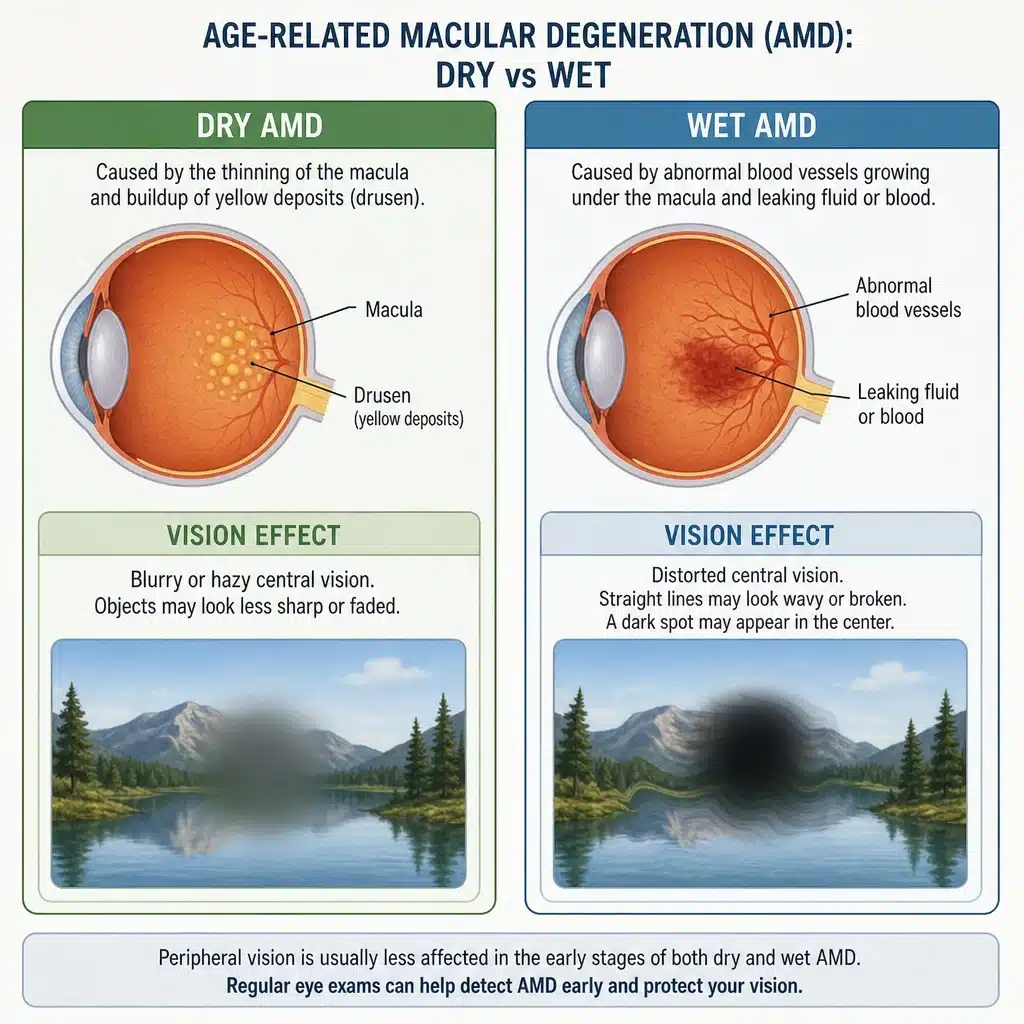
Age-related macular degeneration comes in two forms, and they behave quite differently. All cases begin as dry AMD, and most people diagnosed with AMD have this slower-moving form, managed through monitoring and lifestyle adjustments rather than aggressive treatment. Between 10 and 15 percent of dry AMD cases progress to wet AMD, which is caused by abnormal blood vessels leaking fluid or blood beneath the retina and moves much faster, sometimes causing vision changes over weeks rather than years (National Eye Institute).
What Do Early Symptoms Actually Feel Like?
The early signs of AMD are subtle enough that a lot of people dismiss them at first. Blurred or fuzzy central vision is common, along with new difficulty recognizing faces from a normal conversational distance. Straight lines, doorframes, window blinds, that kind of thing, can start to look bent or wavy, a symptom called metamorphopsia that’s one of the more distinctive early markers of the condition.
Colors may seem slightly less vibrant than they used to, and adjusting between bright and dim lighting can start taking longer than it once did. None of these changes happen overnight, which is exactly why they’re easy to write off as normal aging or tired eyes. If you’ve noticed any of this creeping in gradually, it’s worth mentioning at your next routine eye exam rather than waiting for it to become more obvious.
What Happens When Symptoms Progress?
As AMD advances, central vision changes become harder to ignore. Many people describe a persistent dark or blank patch settling into the middle of their visual field, which can make faces, text, and fine detail genuinely difficult to make out even though peripheral vision usually stays intact. This is part of why complete blindness from AMD is rare, but the impact on reading, driving, and recognizing people can still be significant.
A smaller number of patients with advanced AMD experience Charles Bonnet syndrome, a lesser-known condition where the brain fills in gaps in vision with vivid, sometimes unsettling images that aren’t really there. It can be alarming if you don’t know it’s a recognized part of vision loss rather than a separate neurological issue, and it’s worth discussing with your eye doctor if it happens rather than assuming something else is wrong. Sudden, rapid vision changes at any stage of AMD, especially new distortion or a growing blind spot over just a few days, deserve prompt evaluation through emergency eye care rather than waiting for a routine visit.
What Are the Risk Factors, and How Is AMD Diagnosed?
Age is the biggest risk factor, with real increases after 50, but smoking, family history, and high blood pressure all raise your risk as well. That last one is worth noting, since cardiovascular health and eye health overlap more than people expect, similar to how vascular risk gets discussed during diabetic eye exams. Diagnosis typically combines a visual acuity test, an Amsler grid check for that wavy-line distortion, and optical coherence tomography, an imaging test that lets your doctor see the layers of the retina directly.
What Does Living With AMD Actually Involve?
Living with an AMD diagnosis usually means adapting rather than losing independence outright. Low vision aids like magnifiers and specialized glasses help with reading and close work, and vision rehabilitation services can teach practical strategies for daily tasks that feel harder with reduced central vision. Dr. Taylor Randich often walks patients through these options at diagnosis, since knowing what’s available upfront makes the adjustment period considerably less overwhelming. Connecting with a support group, formal or informal, also helps more than people expect, since a lot of the difficulty with AMD is emotional as much as visual.
Macular degeneration symptoms tend to creep in quietly, which is exactly why they’re so easy to miss until they’ve already progressed. If lines have started looking a little off, or colors seem less vivid than they used to, that’s worth a real conversation through our medical eye care team at your next visit rather than something to brush aside.
FAQs
1. What is usually the very first sign of macular degeneration?
Straight lines appearing wavy or distorted, known as metamorphopsia, is one of the earliest and most distinctive signs. Blurred central vision and difficulty recognizing faces at a normal distance often show up around the same time.
2. Does macular degeneration cause total blindness?
No, complete blindness is rare with AMD since peripheral vision typically remains intact even as central vision declines. It significantly affects detail-oriented tasks like reading and recognizing faces, but full vision loss isn’t the typical outcome.
3. Can dry AMD turn into wet AMD?
Yes, roughly 10 to 15 percent of dry AMD cases progress into the wet form, according to the National Eye Institute, which is part of why ongoing monitoring matters even after an initial dry AMD diagnosis.
4. What is Charles Bonnet syndrome, and is it related to AMD?
Charles Bonnet syndrome causes vivid visual hallucinations in some people with significant vision loss, including advanced AMD, as the brain fills in gaps in the visual field. It’s a recognized, non-psychiatric phenomenon tied to the vision loss itself, not a separate mental health condition.
5. Are there lifestyle changes that actually help with AMD?
Yes, not smoking, eating a diet rich in leafy greens and omega-3 fatty acids, and wearing UV-protective sunglasses are all associated with supporting macular health. These changes matter most for dry AMD, where slowing progression is the primary goal.
6. What tests are used to diagnose macular degeneration?
Diagnosis typically involves a visual acuity test, an Amsler grid test to check for distorted lines, and optical coherence tomography, which images the retina’s layers in detail. Together, these tests let your eye doctor confirm a diagnosis and track any changes over time.