

First visits to any medical provider can feel a little uncertain -even when there’s nothing wrong. If it’s been a few years since your last optometrist eye exam, or if you’ve never had a comprehensive one, knowing what actually happens during the appointment removes a lot of the guesswork. The short version: it’s not painful, it takes about 45–60 minutes for a thorough exam, and you’ll leave knowing far more about your eyes than when you walked in.
Here’s a clear breakdown of the process, from the front desk to when you walk out with your updated prescription.
Before the Exam Begins: Intake and Health History
When you arrive, you’ll fill out a health history form -either on paper or a tablet, depending on the practice. This covers your current vision concerns, any symptoms you’ve noticed (blurry vision, dry eyes, headaches, floaters), your family history of eye disease, your general medical history, and a list of medications you take.
Don’t skip the medications section. Several common drugs -antihistamines, antidepressants, blood pressure medications, and antimalarials -can affect intraocular pressure, dry eye severity, and even the retina over time. Your optometrist uses this information to personalize your exam, not just check boxes.
If you wear glasses or contact lenses, bring them. The technician will measure your existing prescription with an instrument called a lensometer, which reads what correction is built into your current lenses. This serves as a baseline before the doctor starts their own measurements.
A pre-exam technician will often do several measurements before you see the optometrist: visual acuity (the classic letter chart), autorefraction (a machine estimates your prescription), and corneal curvature. Some practices also do preliminary glaucoma screening and retinal imaging at this stage.
The Core of the Optometrist Eye Exam
Once you’re with the doctor, the exam proceeds through several distinct phases.
Cover test and eye alignment. The doctor will ask you to focus on a point while covering each eye alternately. This checks how well your eyes work as a team and whether there’s any underlying misalignment (strabismus or phoria) that might cause headaches or eye fatigue.
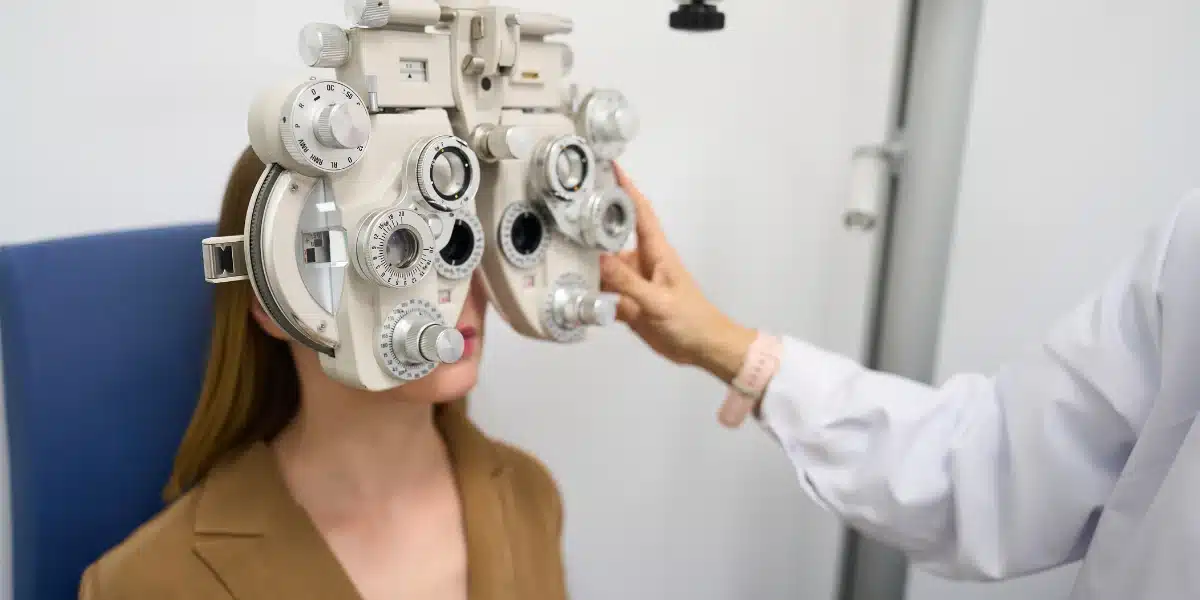
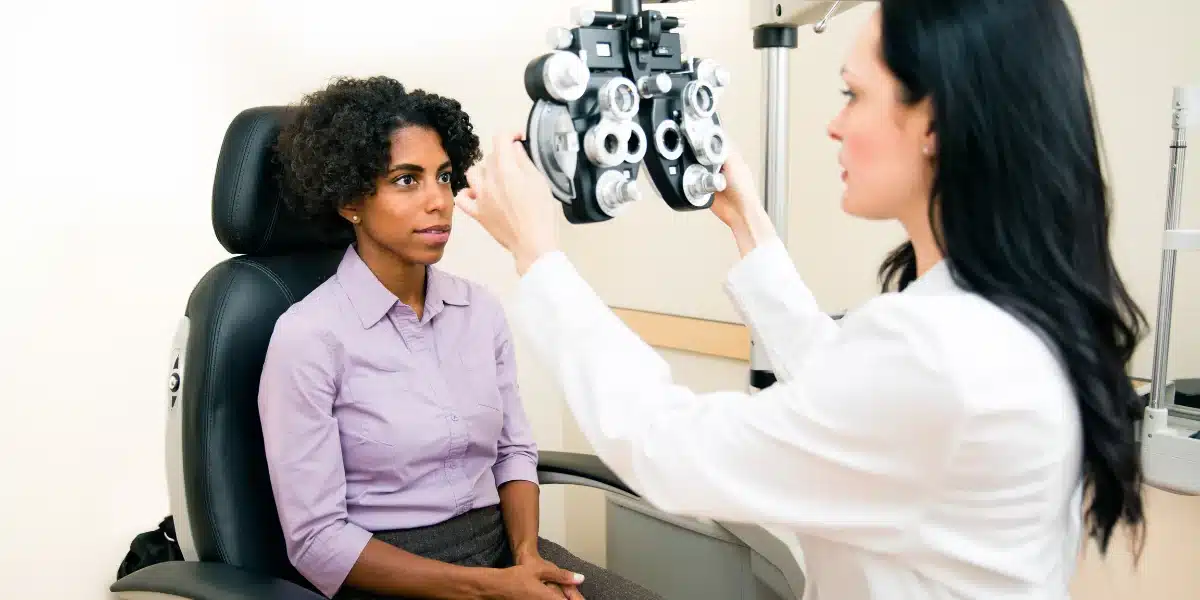
Refraction -finding your prescription. This is the “which is better, one or two?” part. You’ll look through a device called a phoropter, and the doctor will cycle through lens combinations to find the prescription that gives you the clearest, most comfortable vision. It’s not a test you can fail. There are no trick questions. Just say what you actually see clearly, and don’t second-guess yourself. A comprehensive eye exam takes this step seriously -a rushed refraction leads to an inaccurate prescription.
Slit lamp examination. This is the microscope portion of the visit. You’ll rest your chin on a support while the doctor shines a narrow beam of light into each eye to examine the structures of the front of the eye: your cornea, lens, iris, and the drainage angle. This is where conditions like cataracts, corneal scarring, and anterior inflammation get spotted. It’s also where your doctor assesses the health of your conjunctiva and eyelids -chronic blepharitis and meibomian gland dysfunction (the most common cause of dry eye) show up clearly here.
Intraocular pressure measurement. Your eye pressure will be measured, either with the air puff most people dread or with a more precise contact tonometry method. Elevated pressure is the primary risk factor for glaucoma -though normal pressure doesn’t rule it out entirely, which is why the optic nerve evaluation below matters.
Dilated fundus exam. Dilation drops expand your pupil so the doctor can examine the back of your eye: the retina, optic nerve, macula, and the blood vessels that run through it. This is the most important part of the exam for detecting serious conditions like glaucoma, macular degeneration, diabetic retinopathy, and retinal tears. Your vision will be blurry for close-up tasks and your eyes will be light-sensitive for 2–4 hours afterward, so bring sunglasses and plan not to drive if possible.
Not every practice dilates at every visit -some use widefield retinal imaging technology instead. Either way, the back of your eye should be thoroughly evaluated at least every year.
Advanced Technology You May Encounter
Modern optometry practices go well beyond the traditional exam sequence. Depending on your history and risk factors, you may also have:
Optical coherence tomography (OCT). This produces a detailed cross-section of the retinal layers and optic nerve, similar to an ultrasound but using light. It’s invaluable for early glaucoma detection and monitoring macular degeneration before vision loss begins.
Corneal topography. A detailed map of your cornea’s surface. This is standard if you’re being evaluated for contact lens fitting -especially specialty lenses -and it’s essential for detecting keratoconus, a condition where the cornea gradually thins and bulges. If you’ve ever been told your contact lens prescription is hard to get right, corneal topography is likely the missing piece. Learn more about keratoconus evaluation and management to understand what this involves.
Dry eye testing. If you’ve reported symptoms of dryness, grittiness, or fluctuating vision, the doctor may assess your tear film quality and quantity, measure tear breakup time, and examine your meibomian glands -the oil-producing glands along your eyelid margins whose dysfunction drives most chronic dry eye.
At Clear & Company Eye Care , advanced diagnostics are built into the standard workflow rather than added as optional extras. The goal is to find problems when they’re easiest to treat.
Contact Lens Patients: The Add-On Exam
If you wear or want to wear contact lenses, your visit includes an additional contact lens evaluation. This goes beyond your regular glasses prescription. The doctor measures corneal curvature, pupil size, and the way the lens sits on your eye to determine the right lens diameter, base curve, and material for your specific eyes.
If you have astigmatism, need multifocal lenses for presbyopia, or have an irregular cornea that makes standard soft lenses uncomfortable, the fitting becomes more involved. Options like toric lenses, gas-permeable lenses, scleral lenses, and hybrid designs can all be explored. A proper contact lens exam and fitting is the starting point for any of these.
What Happens at the End of Your Appointment
The doctor will sit with you and go over the results. You’ll hear your prescription, learn about any findings -even minor ones worth monitoring -and get answers to your questions. Don’t rush this part. If you have concerns about headaches, screen fatigue, or a family member’s history of a specific eye condition, this is the time.
You’ll leave with a written prescription for glasses and/or contacts, along with any referrals or follow-up recommendations. If your eyes were dilated, the front desk can often arrange for someone to pick you up, or you can wait in a dimly lit area until the drops wear off
If you haven’t had an eye exam recently, it’s a straightforward process. Book an appointment and bring your current eyewear, your health history, and your questions.
FAQs
- How long does a comprehensive optometrist eye exam take?
A thorough exam typically takes 45–75 minutes, including time with the technician, the doctor, and the final prescription review. If you’re also having a contact lens fitting or advanced imaging, add another 15–20 minutes. Plan for at least an hour so you’re not rushed.
- Do I need to have my eyes dilated at every visit?
Not necessarily at every visit, but dilation (or equivalent widefield retinal imaging) should be part of your comprehensive exam at least annually. Some practices use digital retinal photography as an alternative that doesn’t blur your near vision afterward. Ask your provider what their standard protocol includes.
- Will I be able to drive after a dilated eye exam?
Dilation drops blur close-up vision and make your eyes very sensitive to light for 2–4 hours. Distance vision for driving is usually adequate, but many patients prefer to arrange a ride. Bring sunglasses regardless.
- What’s the difference between an optometrist and an ophthalmologist?
An optometrist is a doctor of optometry (OD) who provides primary eye care: exams, prescriptions, and management of many eye conditions. An ophthalmologist is a medical doctor (MD) who specializes in eye surgery and complex disease management. For routine exams, contact lenses, and most non-surgical conditions, an optometrist is the right first call.
- How do I know if my prescription has changed?
Symptoms like increased squinting, headaches after screen time, difficulty reading small print, or blurry distance vision at night all suggest a change. But many prescription shifts are subtle enough that you won’t notice them -which is another reason not to skip annual exams.
- Can children have the same type of comprehensive exam?
Yes, adapted for their age. Pediatric eye exams use a combination of objective tests that don’t require the child to read a chart, along with age-appropriate visual acuity testing. Children should have their first comprehensive exam at 6 months, again at age 3, before starting school, and annually thereafter.
At Clear & Company Eye Care in Harrisburg, NC, we can help. Explore our comprehensive eye exam services or book an appointment online — or call (704) 997-2020.